
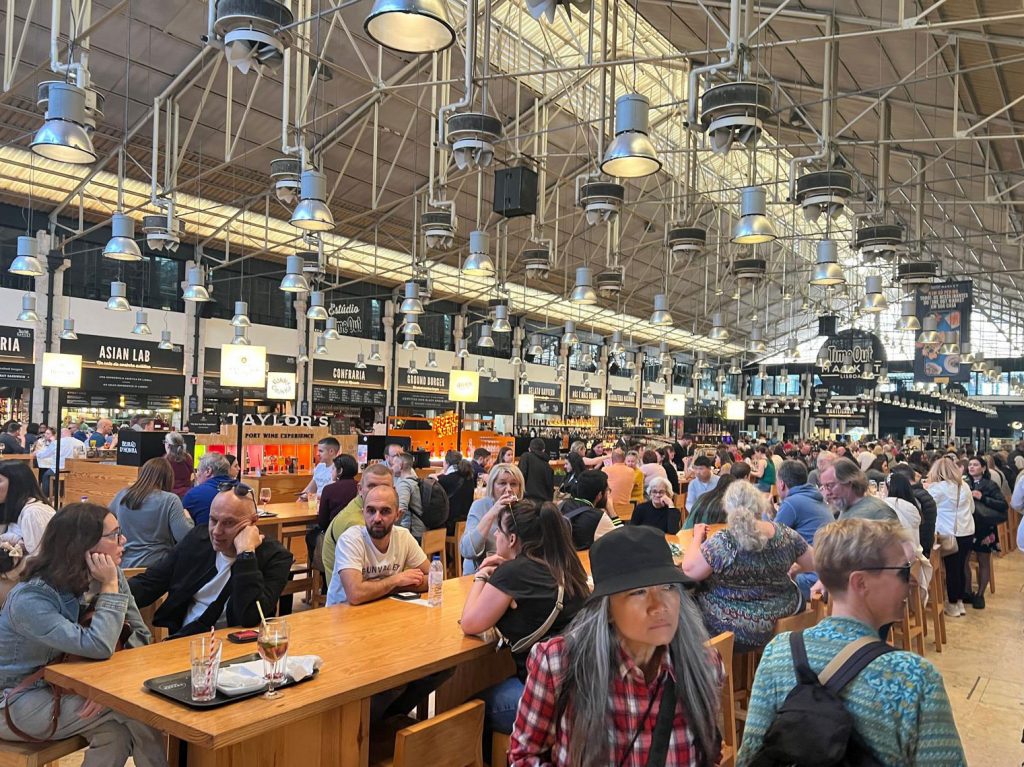
With the Time Out Market Lisboa, Lisbon has seen the emergence of a concept that goes far beyond a traditional market hall. In the historic Mercado da Ribeira, a venue has been reimagined where gastronomy, high standards and a pleasant atmosphere have been translated into a commercially successful model. The market was the very first Time Out Market and opened in 2014. Today, it comprises around 26 restaurants, 8 bars, a dozen or so shops, an events area and a cookery school.
The focus is on the careful selection of vendors. Unlike many food hall concepts, the mix of tenants is not based solely on leasing, but on an editorially curated selection. Time Out describes the principle itself as follows: only the best ideas and concepts in the city, as judged by the editorial team, become part of the market. This results in an offering with a distinct character that clearly differs from traditional food courts and gives the location a unique profile.
Particularly interesting is the blend of market tradition and contemporary use. The Time Out Market is embedded within an existing market building and thus benefits from an authentic, historically evolved setting. At the same time, this location has been developed in such a way that it has become a high-traffic attraction with international visibility and a palpable quality of stay. The project thus clearly demonstrates how a site steeped in tradition can be revitalised through the right selection of tenants, a strong brand and a clearly defined visitor experience. The site appeals to locals as well as visitors to the city and, thanks to the quality of its dining options, has become a destination in its own right. This early model has since been adopted in many places: moving away from a purely functional offering towards a place defined by its selection, atmosphere and relevance. Beyond the market itself, the impact on the surrounding area is also remarkable.
The City of Lisbon explicitly frames the regeneration of the Mercado da Ribeira as part of a broader revitalisation of the Cais do Sodré area, linked to an enhancement of the local dining scene and new opportunities for employment. At the same time, academic studies describe Cais do Sodré as an example of tourism-driven urban transformation. The Time Out Market was not the sole catalyst, but it was clearly a visible component of this development. For us, therefore, the term ‘gentrification’ is less crucial than the realisation that successful food and leisure concepts often have an impact far beyond the property itself and can reshape entire neighbourhoods – in a positive way, but also with the familiar tensions that intense tourist activity brings with it.